If you read something Wednesday morning and it’s still bugging you on Friday afternoon, don’t keep having a conversation in your head, write about it.
A few days ago, yet another hand-wringing, oh-dear-what-shall-we-do-about-it post about students and their phones came through my Twitter feed. Over at Faculty Focus, Maryellen Weimer offers her advice about “The Age of Distraction: Getting Students to Put Away Their Phones and Focus on Learning.” She summarizes some research by Jeffrey H. Kuznekoff and Scott Titsworth which joins Duncan, Hoekstra & Wilcox (2012) in telling us students are distracted by their phones and learn less. I’m not questioning whatsoever the validity of these works. Doug Duncan is a friend and colleague but all he admits that their paper is saying is there’s a correlation between cell phone use and student learning.
It’s when people attribute causation that my blood starts to boil. “My students aren’t learning because they’re on their phones. What can we do about it? How can we get them to pay attention? It’s for their own good…” Yadda yadda yadda.
Here’s what I think:
Sticks
Carrots
Don’t ban phones and laptops from class.
Do make what happens in class more interesting and worthwhile than what they can find on their phones. Or find activities where they can use their mad searching, tweeting, texting, drawing, instagramming skills.
Don’t show them a graph of student marks vs phone use (Learning to interpret graphs is, itself, a learning objective of many instructors. It’s a skill that takes a lot of instruction and practice. Slapping a graph on the screen and saying, “See!” even if you try to explain it, is unlikely to have much impact.) or do some other phone-y demonstration to prove to them they’re not learning.
Do help them learn by getting them engaged with your content. Like a lifeguard that says, “Walk on the pool deck, please!” instead of “No running!”, show them what they can do, don’t tell them what they can’t.
Don’t start from the assumption that students will be on their phones and the instructor needs to find ways to get students to “put away their phones.”
Do with start with the goal of engaging students so that they have neither the time nor the desire to pull out their phones.
Is it naive to think it’s possible to keep them engaged? No. Instructors using peer instruction with clickers can keep their students’ attention. And, yes, these instructors still lecture: for a maximum of 10 minutes after they’ve used some clicker questions to ensure the students are “prepared to learn,” as Dan Schwartz would say.
Is it easy to keep students engaged for 50 minutes? No, but no one ever said teaching is easy.
* the title is my portmanteau of the expression, “If all you have is a hammer, everything looks like a nail” and the “carrot and stick” approach to driving your ass, er, mule.
I have a thing about learning my students’ names. And it’s not a good thing.
I think I have a fixed mindset when it comes to learning people’s names: I believe I can’t do it. So whenever someone introduces him- or herself, a piece of my brain shuts off for a couple of seconds and the name go in one ear and out the other. That’s really annoying when I can’t call them by name just 5 seconds later!
The first step is admitting I have a problem, right? These days, I deliberately “activate” my brain when I’m about to meet someone: Okay, here comes somebody new. Listen for their name. Listen…listen…listen…got it! “Nice to meet you, [insert name here]”
Of course, I ignore all this advice when it comes to students in my classes. I used to teach introductory astronomy with 200-300 students. I mean, c’mon, what am I supposed to do, learn all their names? Bah, forget about it.
A Critical Moment
Then something happened last summer. I was observing a class at UCSD taught by one of our Summer Graduate Teaching Scholars — Ph.D. students selected to teach a course in Summer Session with support from the Center for Teaching Development. David was teaching an anthropology class about multiculturalism to about 50 students. His goal was to regularly spark discussion in class, getting students to share their own diverse cultural experiences. At first, David easily called on about half a dozen students by name, most of whom sat near the front of the room. “Uh-oh,” I thought to myself, “he knows the names of the enthusiastic students, potentially excluding the others from the ‘teacher’s pet’ club.” Someone else put up a hand and then David did something that still sticks in my memory: he looked right at the student, said, “Yes…uhhh…” and looked down at his classlist with student photos and names, found the right person, “…John*, what would like to add?” [*it wasn’t John, I don’t think. I wasn’t listening. See above.] David made it clear he wanted to learn their names and they saw the effort he was putting into it. Later in the same class, he called on someone at the back of the room, by name, who he remembered had written something about the event they were discussing.
Even though the room was narrow and dark, with the studnets on one end and David on the other, it felt like a community. They were all learning together. People engaged all over the room, not just the front rows. Wow. I believe that David knowing his students’ names was a critical factor in that success.
Fall 2013 – My Turn
When it was my turn to teach again, a class for 40 grad students and postdocs about teaching and learning in higher ed, I vowed to learn their names. I made a print-out of their names and photos (pro tip: alphabetized by first name). When they were working in small groups, I took the time to deliberately look at each student and recall his or her name, consulting my cheat sheet only when necessary. Honestly, it didn’t take long before I was comfortable calling them by name. And it was great, especially since I was able to link their blog posts with their faces and could say, “Amy, you wrote about that on the blog. Could you share what you wrote with us?”
Winter 2014
I’m about to teach this same class again, this time with 64 students. As I spent a precious holiday afternoon sitting at my computer downloading and formatting students pictures into a class list, I wondered if it was really worth the effort. Wondered on Twitter, that is:
Hey, #highered instructor friends! On a scale of 1=waste of time to 5=crucial, where do you rank learning your students’ names?
What a thrill to open Twitter a few hours later and see my timeline full of responses. Almost everyone agreed that it’s crucial but more difficult to accomplish, the larger the class:
@polarisdotca scales with size of class, but normally right up there around 5
Some were clear that it’s not easy in really large classes:
@polarisdotca Good question. I’d say somewhere around 4-5 for smaller classes. Huge lecture classes, impossible. — ✜ Stephen Ransom (@ransomtech) January 2, 2014
@polarisdotca Depends on the size of the class. In a class of 80, I’ll try to know most (3). In a class of 200, forget it (1). — Spencer Bagley (@sbagley) January 2, 2014
On the other hand, class size doesn’t bother @raulpacheco:
.@polarisdotca I have always made it my priority to learn my students’ names and to this day, I remember ALL of them. Even with 120 folks — Dr Raul Pacheco-Vega (@raulpacheco) January 2, 2014
@bfwriter noticed that @kellecruz says she learns the names of her engaged students:
@kellecruz@polarisdotca aren’t the disengaged students the ones who need you most? might you convert them by making an effort to interact? — barefootwriter (@bfwriter) January 2, 2014
To which Kelle elaborated
@bfwriter among 300, I’m only gonna learn names of the students who regularly ask questions/come to office hours. @polarisdotca
In a word, yes. Learn as many names as you can. Even if you only learn half of them, it may seem to the students that you know them all. And that feeling of connection and community might be enough to get all of your students engaged and learning.
How do YOU do it?
Do you learn your students’ names? If you have a good method, would you leave a comment to share it with us? Thanks!
Update: January 24, 2014
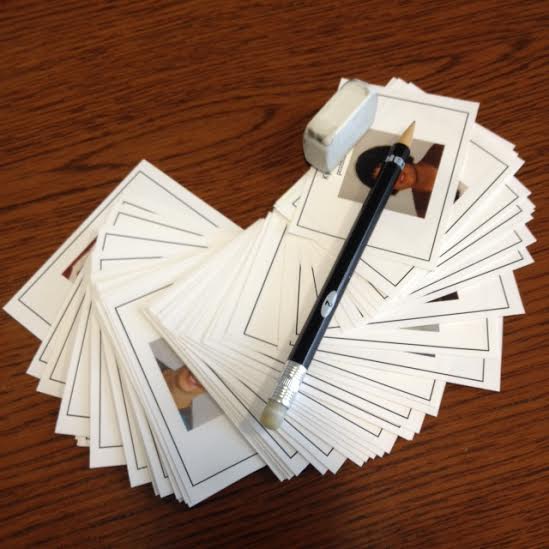
Writing this post motivated me to learn my students’ names, all 60 of them. I made a PPT deck with 1 slide for each student’s name, program (“grad student, Biology”) and photo. I printed these slides as 9-up handouts and cut them, to get a stack of index cards I carry around and continually flip through. I worked hard at it and within a few days, I could name each student.
I mades cards, one for each student, giving their names, programs and pictures.
I’ve been teaching my class for 3 weeks now and knowing my students’ names and faces is working great in both directions, faces-to-names and names-to-faces:
when a student walks into the classroom, I can say, “Hi, Bob. How’s your week going?”
when a student asks a question or makes a comment, I can say, “Yes, Bob, you’ve got something to add?” and “Thanks, Bob, that’s really interesting.”
when they write blog posts (and they wrote some good ones), I read the author name, and picture the student in my head. Later, when I see that student in class, I can say, “Great post, Bob, I really like how you wrote…”
similarly, when I’m teaching and remember something relevant that I read in a blog post, I can look around the room and say, “Bob, you wrote about that. Would you tell us about it?”
On the first day, I’d see them coming up the hallway to class and could have said, “Hi Bob, great to meet you in person.” That felt a little creepy because we’d never met. Instead, I stuck out my hand, “Hi, I’m Peter” and then listened very deliberately to make sure the name they replied with matched what I was expecting. That gave me a way to check the pronounciation, too.
The students sit in 3’s and 4’s at tables in my classroom and I notice they often introduce themselves when they do group work. As Danielle writes in the comments, the students benefit from knowing each other’s names, too.
Update: February 21, 2014
“Oh sure, I learned their names,” I convinced myself. I stopped quizzing myself with my stack of index cards. And the next week, drew a blank on student after student! I guess it’s no surprise I’d forget the names of people I see only once per week in a group of 20 but it’s really frustrating to forget students’ names when you know you knew them.
So, I’m back to quizzing myself with the index cards. Before each class, I flip through the cards, slipping the ones I get wrong back into the deck. Seems to be working because this week, I didn’t make any mistakes.
I’ve spent time in that circle of Hell called “marking” (or “grading” as they call it here in the U.S.) My past is filled with stacks of math exams full of multi-step problems and astronomy exams with essays about the nature of science. The only respite from the drudgery of marking are the answers so absurdly incorrect it makes you laugh or the answers that are exactly what you’re looking for – check, check, check-check, check, check, perfect! 10/10.
Happily, I don’t have to mark exams anymore, but I still have an chance to get the tiny squirt of adrenaline that comes from assessing those “exactly what you’re looking for” answers.
I teach a teaching and learning course in the Center for Teaching Development at UCSD called The College Classroom to graduate students and postdocs. Their last assignment is a “microteaching experience.” Traditionally, this involves developing a lesson for a class they might teach someday, delivering that lesson to their fellow students and then getting feedback from their peers and instructors. That’s is a good way to assess the ability to lecture, maybe even the ability to orchestrate some active learning into the lecture, but that’s still only one part of “teaching.” What about all the things that happen before class and after class?
Instead, we ask the students to create lesson plan for a 50- or 80-minute class. It should contain
learning outcomes
pre-class tasks like readings, watching videos, exploring websites with clear guidance about what to focus on
pre-reading quiz to assess the pre-class tasks
a skeleton of the lesson, including 3-5 peer instruction (“clicker”) questions but excluding the PowerPoint slides with all content – I don’t want them wasting their time making pretty slides they may never use
several assessment questions that could appear in homework or on the exam
For their presentation, we meet in small groups — me, the TA, and 3 of them — and I ask them to pretend they’re sitting in the coffee room with a few of their colleagues, describing this awesome lesson they’ve planned. They’ve got less than 10 minutes and they should assume everyone present knows the content and can concentrate on the pedagogy. (“In other words, don’t teach us the chemistry. Assume we know it. Tell us how you’ll teach it and why that’s a good approach.”)
When I assign the microteaching task a few weeks before the end of the course, I give them a lesson plan rubric (PDF). It’s using this rubric to assess their presentations that I get those “check, check, check-check, check” moments of satisfaction.
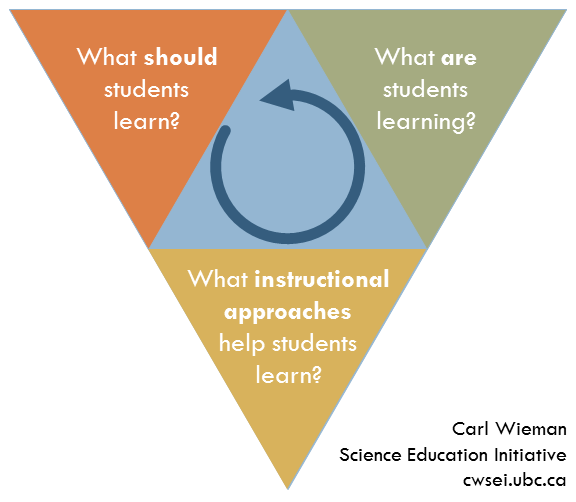
The CWSEI’s 3-pillared approach to course design. (Image adapted from CWSEI by Peter Newbury CC-BY-NC)
Step 1. Set the learning outcomes What should students learn? What should they be able to do to demonstrate their understanding and mastery of the concepts and skills? These outcomes are statements that complete the sentence, “By the end of this lesson/unit, you’ll be able to…” and start with a nice, juicy verb selected from Bloom’s taxonomy of the cognitive domain.
Step 2. Decide how you’re going to teach What instructional approaches help students learn? What does the literature tell you about how people learn those skills and concepts? I’m a strong supporter of lecture…in 10-15 minute snippets, when the students are prepared to learn because you’ve primed them through student-centered activities like peer instruction, in-class worksheets and demonstrations, or pre-reading.
Step 3. Assessment What are students learning? Create formative and summative assessments that evaluate students’ mastery of the learning outcomes.
Two important things to notice about this approach:
When it works, it works great. Here’s what I wanted students to know, here’s how I taught it, here’s what they did on the exam. Check, check, check.
When it doesn’t work, it still works great. If students don’t perform like you’d hoped, the pillars help you diagnose the “failure mode,” as my engineering friends would say. Maybe it was a bad exam question that didn’t assess what you wanted to teach. Maybe you didn’t teach it in a way that helped them learn. Maybe you set an unrealistic learning outcome. In other words, you can re-trace through the course design cycle to find out what went wrong.
The College Classroom Microteaching Presentations
When the participants in The College Classroom present their lesson plans, it’s great when I can identify this nice, tight package of learning outcomes, instruction and assessment – check, check, check! I make sure I tell them, hoping that positive feedback will motivate them to do it again. As with marking exams, it’s the incomplete lessons that are difficult to assess. Fortunately, 3-pillared approach together with the rubric makes it easier for me to give targeted, goal-directed formative feedback.