
Category: teaching

Meta-blog-nition

“Cognition” is another word for “thinking”. Metacognition, then, is thinking about your own thinking. Cynthia Brame at Vanderbilt’s Center for Teaching has this terrific quote by John Flavell in her post, Thinking About Metacognition:

I am engaging in metacognition if I notice that I am having more trouble learning A than B.   John Flavell (1976)

Metacognition is thinking about your own thinking.

One of the key findings about how people learn is that we need to metacognitive about our learning. Indeed, one of the signs of expertise is an “internal dialogue” — a little voice in your head — that continually questions what you’re doing, how well you’re doing it, why you’re doing it.

If teaching is about making your students more like experts, metacognition should be important. It’s already challenging to draw out and build on student’s pre-existing knowledge and teach the multitude of facts and concepts AND the conceptual framework which link those facts together. (These are the other two Key Findings of How People Learn.) How do you teach students to be metacognitive? It’s not like there’s a switch you flick on (“Everyone, please think about your thinking. Thank-you.”) Like any skill you’re teaching, students need practice being metacognitive before they’re good at it.

My frustration with coming up with metacognition practice made me all the more amazed and pleased by the responses I got when I asked my students to write a blog post. The course I’m teaching, The College Classroom, is about teaching and learning in higher education. My students are advanced Ph.D. students and postdocs about to embark on academic careers. Prior to our class on deliberate practice, I asked them to write a blog post about a time when they’ve engaged in deliberate practice. Write they did, and over and over, their posts progressed from a description of what they did to how well they did it and why they did it. They wrote about time management, aiming high, running, running, learning Zapotec, driving, rodent neurosurgery, entrepreneurship, guitar, math, practice, teaching, coaching volleyball, learning English, piano, math, learning Italian, studying, soccer, tae kwon do, soccer, guitar, learning Spanish, soccer, regret, writing, macroeconomics, writing, piano, Scabble, improv, soccer, crafting conversations, and Vespas.

It’s metacognitive blogging
— meta-blog-nition —
pouring out onto the page!

The moral of the story: if you’re an instructor struggling to create opportunities for your students to practice being metacognitive, get them blogging. As an added bonus, their posts are a wealth of pre-existing knowledge and experiences you can build on. That’s a win for everyone.

What about you? When are you metacognitive? What do you do to get your students to think about their own thinking? Leave a comment to share it with the rest of us!

Preparing for 2 sections of the same class

More grad students and postdocs want to take the course we teach at UCSD about teaching and learning in higher education, The College Classroom, than we can accommodate. This Quarter, we accepted 40 participants. The class meets for one 90-minute class each week. Because of scheduling and the availability of classrooms, I’m teaching it in 2 sections, one on Tuesday and one on Thursday.

It’s the 3rd time I’ve taught the class so I’m more confident in the content and in how I present it to the class. I don’t get caught in metacognitive loops figuring out how to teach about teaching. As much. The little bit of cognitive load available has allowed me to more closely assess my teaching.

I noticed something around Week 4: I’m not happy with how things go on Tuesdays. I always feel better about my Thursday classes. Why is that, I wondered? Here’s what I think is going on:

I usually prepare the slides for the next class on the previous Friday or Monday. The slides are minor revisions to the ones I used last time so preparing for class is pretty easy. When I’ve made the revisions, I click through the slides to make sure they’re in the right order, any PPT animations are working, remind myself of how the student-centered activities will run, and so on.

Denial

And then I teach Tuesday’s class. I’m pretty careful about properly preparing for the activities – we use peer instruction with clickers, portable whiteboards, look at handouts and other things – so those activities usually go well. But there are times when I advance to a new slide and think to myself, what was this for again? That’s bad. And that’s when I’m not happy about how I taught the class.

Advance to Thursday. The class goes much better:

  • I’m better prepared: I know why each slide is in the deck
  • I can better anticipate how the students will react and build that into the lesson because I’ve seen how Tuesday’s students reacted.

How can I do that the first time, too?

The week after I recognized this pattern, I made a deliberate effort to spend some time  on Monday, working my way through that week’s slides. Really reading them and thinking about the content. And guess what? The Tuesday class was great!

Guess what else happened? I was so confident after Tuesday’s class, I breezed into Thursday’s class without reviewing the slides and sucked. In my opinion.

The moral of the story. I need to deliberately and carefully prepare for each and every class. I’m sorry, especially for the Tuesday students, that it took me this long to realize that.

Regrets? Yes. And no.

My trek from geeky highschool student to Associate Director at the Center for Teaching Development at the University of California, San Diego has definitely followed the alternative academic career path.

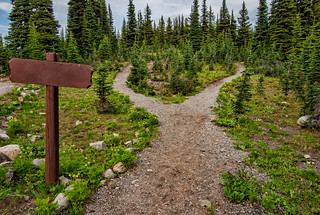
You Choose Your Path

When I finished my Ph.D. at the University of British Columbia in Vancouver, I jumped off the tenure track to teach math at a 2-year college in Vancouver.  A few years later, I stepped halfway back into the Ivory Towers when I split my time between teaching introductory astronomy (#astro101) in the Department of Physics and Astronomy at UBC and being the resident astronomer at the H.R. MacMillan Space Centre (aka, the Planetarium) in Vancouver. I eventually ended up full-time in Physics and Astronomy at UBC, not on the tenure track but as a Science Teaching and Learning Fellow in the Carl Wieman Science Education Initiative. (Is there an adverb-form for gobsmacked or mind-blown? Oh well…) Gobsmackedly, I was in the office across the hall from where I’d first met my M.Sc. supervisor, Bill Unruh, some 18 years earlier. Now, I’m a faculty member in the Center for Teaching Development at UCSD, with the rank of Academic Coordinator.

Never have I been on the tenure track. Never have I been able to put “Professor” on my business cards.

And because of that, I have one regret (one is enough for this post): I’ve never felt the satisfaction and pride of having a graduate student. Because that’s what professors do, to move their disciplines forward. It’s their shoulders that the grad students stand upon to see further. When I hear from colleagues about the success of their students, I feel a wave of regret.

This summer that wave  was reduced to a twinge.

Part of my job at UCSD is to teach a class called The College Classroom about teaching and learning to graduate students and postdocs. Some of the graduate students become Summer Graduate Teaching Scholars (SGTSs) and teach a course in the Summer session. As part of our ongoing support, I observe each SGTS’s class 2 weeks into the 5-week marathon and give them some formative feedback.

And it was there, sitting in the back of those classes, that my wave of regret was reduced to a twinge. This summer, I witnessed first-time-ever instructors

  • running flawless peer instruction with clickers
  • drawing out students’ preconceptions and immediately integrating them into the lesson
  • creating a supportive learning environment where students feel free to discuss their personal, sometime quite, experiences
  • make every single one of the 5o students  in the room feel like they have a critical contribution to make to the class
  • ask the perfect question to ignite a conversation that experts in the field would have

Sometimes I sat there thinking, “Seriously? How did she know to do that? Awe. Some.”

Can I take all the credit? No, of course not, no more than a supervisor can take all the credit for grad student producing a succesful thesis. But I definitely had a role to play and, man, does it feel good.

And, so, what about my circuitous trek through higher ed? No regrets.


Postscript

If you find yourself on a alternative academic path or you’re approaching the fork between tenure-track and not tenure-track, get on Twitter and follow the #altac hashtag. There are many others like you struggling with the same decisions you’re making.

Navigation